
Quick answer: To start watercolor you need just four things — a small set of pans, one round brush, 300gsm paper, and water. Begin with simple flat washes, let layers dry between passes, and mix your colors from a few primaries. An all-in-one kit like the Travel-Ready Kit gives you everything in one case so you can paint today.
Watercolor has a reputation for being hard. It isn’t — it’s just different from other paints, because water does half the work. Once you understand a few basics, you can make something beautiful on your first afternoon. Here’s everything a beginner actually needs to know.
What you need to start (and what you don’t)
Ignore the giant supply lists. Four things are enough:
- Paint: a small set of 8–12 pan colors. Pans (dry blocks) are easier and cleaner than tubes for beginners. Student-grade lines like Winsor & Newton Cotman or Schmincke Akademie are affordable and genuinely good.
- One brush: a round brush (size 4–6) does 90% of everything when you’re starting.
- Paper: this matters most. Use at least 300gsm watercolor paper so it doesn’t buckle. Cotton paper is best, but good 300gsm is fine to learn on.
- Water + a cloth: one jar to rinse, one to keep clean, and a rag to control your brush.
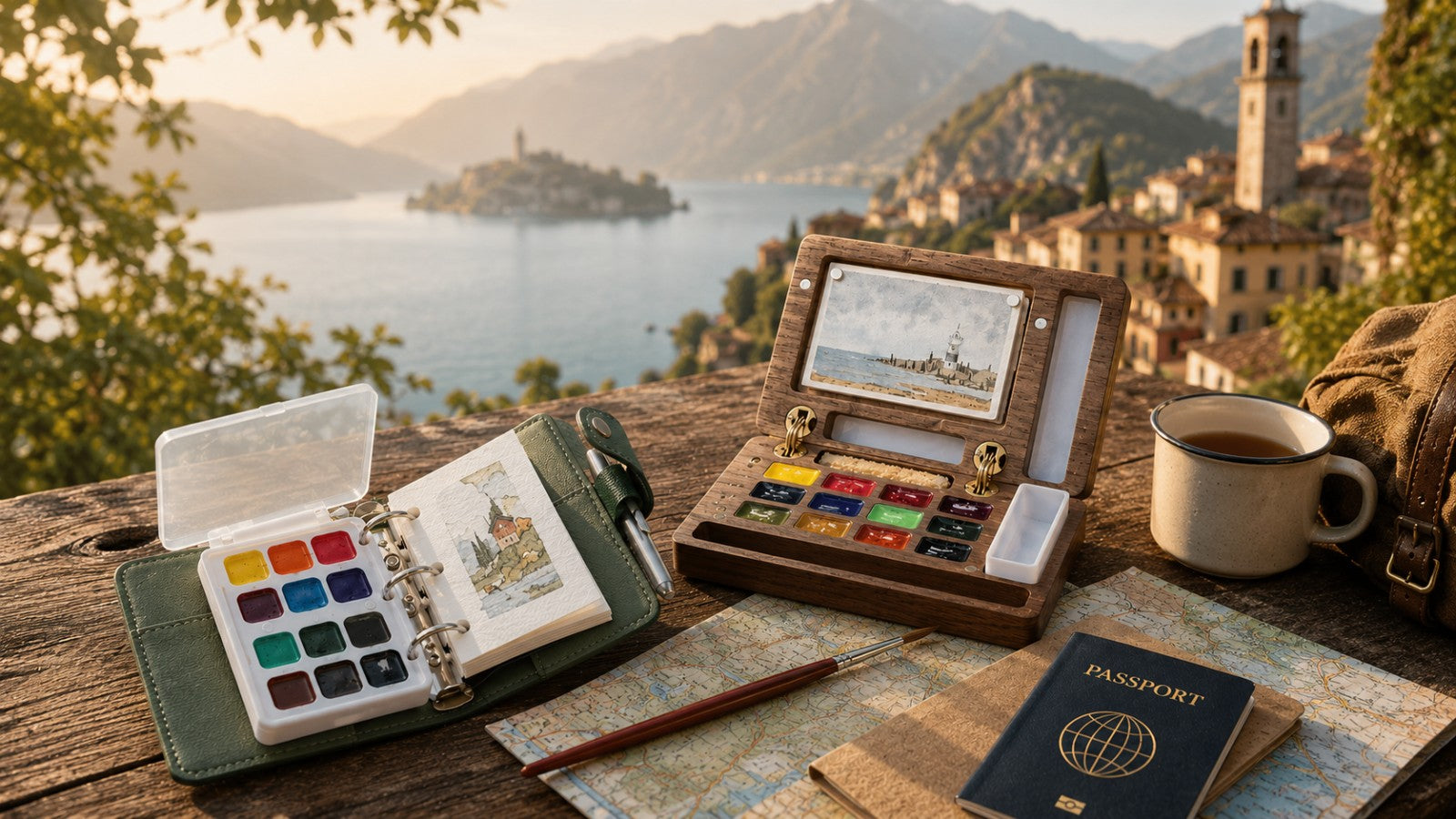
If you’d rather skip the shopping, an all-in-one kit bundles all of this into one case. A compact Travel-Ready Kit or Mini Adventure Kit is an easy first buy; if you want a complete leather kit you’ll keep for years, the Nomad Kit is the popular pick. (See our full buyer’s guide to compare.)
The 3 techniques that cover almost everything
Master these and you can paint most subjects:
- Flat wash: load your brush with watery paint and pull even, overlapping strokes across the paper. This is your sky, your background, your base layer.
- Wet-on-wet: wet the paper first, then drop in color. It spreads into soft, dreamy blends — perfect for skies, water and clouds.
- Wet-on-dry (layering): paint on dry paper, let it dry, then add another layer on top. This builds detail and depth. Patience between layers is the whole secret.
Color mixing without the theory headache
You don’t need 36 colors. With a warm and cool version of each primary (red, yellow, blue) you can mix almost anything. Two quick rules:
- Start light, build dark. Watercolor only gets darker, never lighter — you can’t “undo” with white. Leave the white of the paper for your highlights.
- Mix on the palette, not the paper (at first). Once you’re comfortable, mixing on the paper gives livelier results.
A 10–12 color kit is plenty to learn on. More colors (like the 24 in the Nomad or 33 in the Voyager) just save mixing time later.
5 beginner mistakes (and the fix)
- Too much water on cheap paper — it buckles and pills. Fix: use 300gsm paper.
- Going dark too fast — you lose your lights. Fix: build up in thin layers.
- Overworking a wet area — it turns muddy. Fix: put the brush down and let it dry.
- Muddy colors — usually from rinsing in dirty water. Fix: two water jars.
- Buying too much gear — overwhelm kills momentum. Fix: one small kit, one brush, start today.
Your first 20-minute exercise
Paint a simple sunset: wet the top half of the paper, drop in a warm yellow then a soft orange and let them blend (wet-on-wet). Once dry, paint a dark tree line along the bottom on dry paper (wet-on-dry). That’s two techniques, one finished painting, in twenty minutes.
Frequently asked questions
What supplies does a watercolor beginner really need?
Just four: a small pan set (8–12 colors), one round brush (size 4–6), 300gsm watercolor paper, and water. An all-in-one kit bundles all of these, which is the simplest way to start.
Are pans or tubes better for beginners?
Pans. They’re dry, mess-free, and ready to use with a wet brush — ideal while you learn. Tubes are better later for mixing large washes in the studio.
How many colors do I need to start?
A 10–12 color set is plenty. With a warm and cool version of each primary you can mix almost any color you need.
Why does my watercolor paper wrinkle?
The paper is too thin for the water. Use at least 300gsm paper (cotton is best) and it will stay flat.
Can I learn watercolor with a cheap travel kit?
Yes — a quality all-in-one travel kit with real student-grade paint and 300gsm paper is a great way to learn, and it makes it easy to practice anywhere. See our best travel watercolor kits guide for options.

Laat een reactie achter
Deze site wordt beschermd door hCaptcha en het privacybeleid en de servicevoorwaarden van hCaptcha zijn van toepassing.